

 Executive Summary
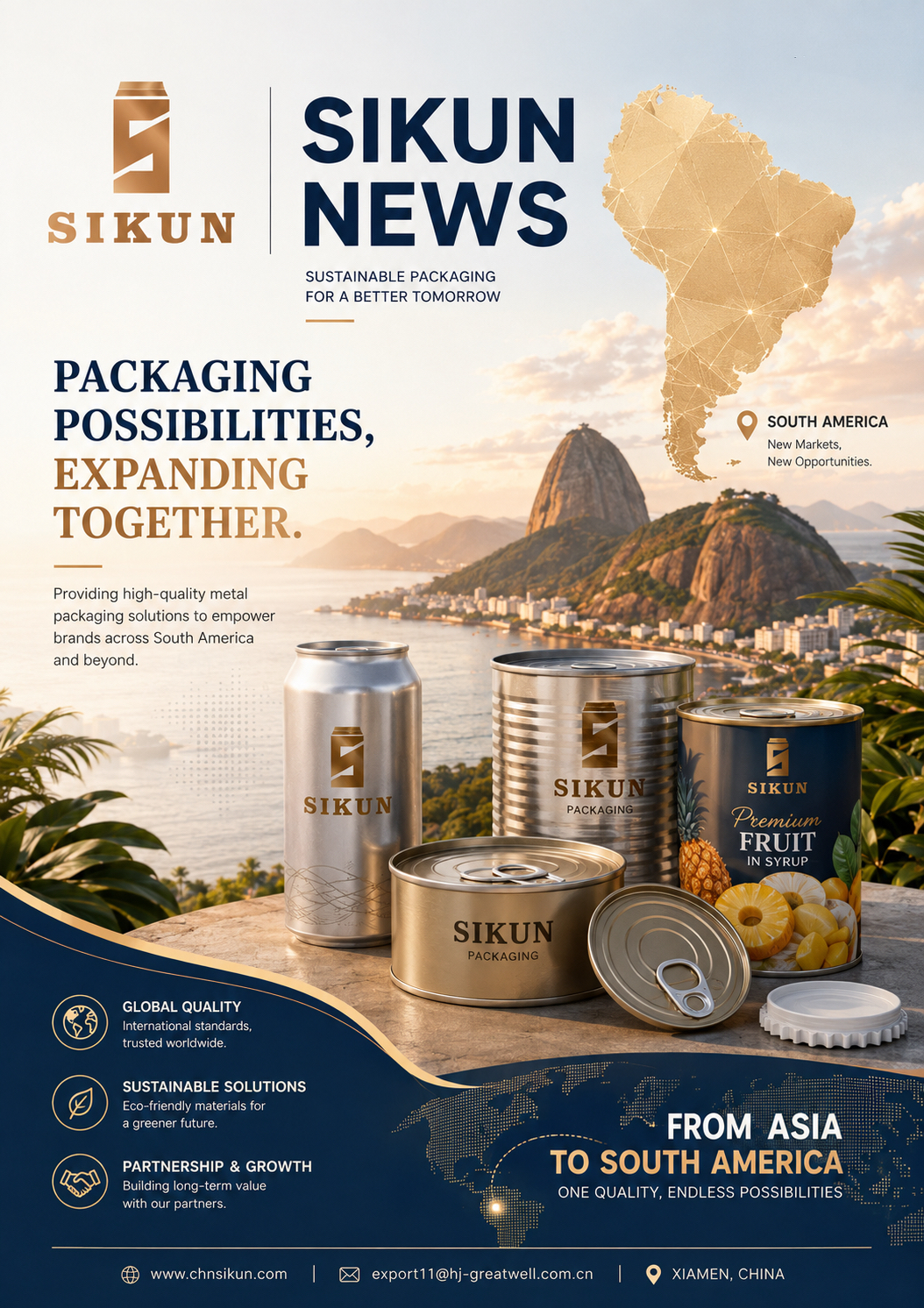
Driven by stringent environmental regulations, “Zero Landfill” policy mandates, and an accelerating consumer shift toward sustainable alternatives, South America has emerged as one of the most dynamic growth regions for the global metal packaging industry. This report provides a comprehensive analysis of market sizing, product segmentations, regulatory drivers, and cross-border supply chain strategies—highlighted by cross-regional expansion initiatives like SIKUN Packaging’s “From Asia to South America” model.
The metal packaging market across Latin America and South America demonstrates steady expansion, anchored by robust recycling infrastructure and strong demand across the beverage and processed food sectors.
As the largest economy in South America, Brazil drives the majority of regional consumption:
- • Beverage Can Market: Valued at $3.705 billion in 2025, Brazil’s beverage can sector is forecasted to reach $5.688 billion by 2033, compounding at a CAGR of 5.5% between 2026 and 2033. Brazil currently accounts for approximately 8.2% of the global beverage can market share.
- • Food & Beverage Advanced Packaging: The Brazilian advanced packaging market for food and beverages is estimated at $798 million in 2026 and is expected to hit $1.015 billion by 2031 (CAGR of 4.9%).
Base valuation of $12.48 billion (2025) reaching a target valuation of $14.57 billion (2030) at a 3.14% CAGR. Growth is primarily driven by Zero Landfill targets, corporate ESG compliance, and aggressive plastic substitution.
Base valuation of $3.705 billion (2025) reaching a target valuation of $5.688 billion (2033) at a 5.50% CAGR. Driven by a surge in craft beer, sugar-free RTD beverages, and world-leading recycling infrastructure.
Base valuation of $798 million (2026) reaching a target valuation of $1.015 billion (2031) at a 4.90% CAGR. Driven by agricultural export growth and heightened demand for extended shelf-life solutions.
The product portfolio featuring two-piece aluminum cans, three-piece tinplate food cans, shallow seafood cans, and Easy-Open Ends (EOE) aligns directly with South America’s core import and manufacturing requirements.
- Market Demand: Aluminum cans represent the fastest-growing material segment. Categories such as beer, RTD teas, sparkling water, and organic energy beverages.
- Key Advantages: Superior thermal conductivity, lightweight shipping, and infinite recyclability.
- Market Demand: Key agricultural exporters across Chile, Peru, Brazil, and Colombia for fruit, legumes, and tomato paste.
- Key Advantages: Total light barrier, structural integrity under high-temperature sterilization, and prolonged shelf life.
- Market Demand: Coastal economies like Peru, Ecuador, and Chile for tuna and sardine processing hubs.
- Market Demand: Fast-paced urban lifestyles are elevating EOE lids—both Full-Open and Stay-On Tab (SOT) variants—to an essential requirement.
- Circular Economy Benchmark: Brazil maintains an aluminum can recycling rate near 100%, supported by an integrated network of 36 major recycling centers.
- Regulatory Push: Strict municipal and federal waste-reduction mandates are compelling FMCG conglomerates to phase out single-use plastics.
- Domestic Consumption Revival: Resurgence of tourism (generating nearly $6.9 billion in Brazil) has boosted demand for portable packaged goods.
- International Quality Compliance: Agribusinesses require packaging that complies with FDA and BRC certifications for North American and European exports.
“FROM ASIA TO SOUTH AMERICA: ONE QUALITY, ENDLESS POSSIBILITIES”
- Global Quality Standardization: Fulfilling high-precision specifications where local production capacity faces shortfalls.
- Turnkey Sustainable Solutions: Exporting lightweighted substrates to meet ESG metrics without sacrificing integrity.
- End-to-End Product Synergy: Integrated solutions from printing to closures, lowering procurement overhead.
- • Focus on High-Growth Hubs: Establish localized distribution networks centered around Brazil and the Andean Region (Chile/Peru).
- • Obtain Environmental Certifications: Provide verified material traceability to pass ESG vendor audits by multinational FMCG brands.
- • Offer Integrated Bundling: Deliver complete turnkey packages—lithographed cans, precision lids, and technical support.
Post time: Aug-12-2026